
Egyptian Auditing Standard No. (260) – Communication with Those Charged with Governance
Egyptian Auditing Standard No. (260) – Communication with Those Charged with Governance From Formality to Professional Partnership (Old Version vs. 2025 Edition)
 Amer Ibrahim - • External audit and audit
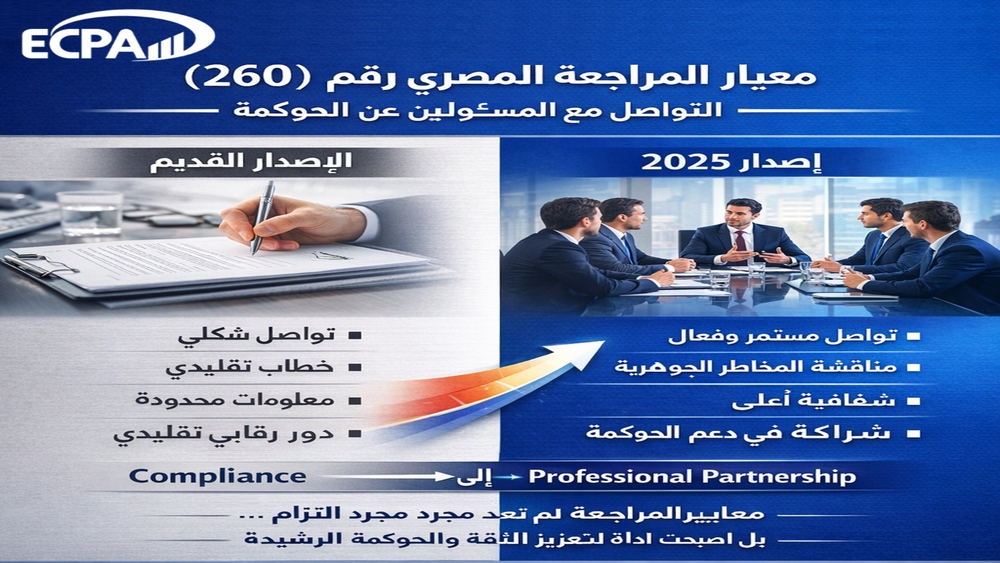
From Formality to Professional Partnership (Old Version vs. 2025 Edition)
Egyptian Auditing Standard (260) is considered one of the key links between the external auditor and the governance structure within an entity. It defines how professional judgments and significant findings are communicated to those responsible for oversight and supervision.
The 2025 edition represents a qualitative shift in this standard. Communication is no longer merely a formal requirement; it has become a central element in supporting governance and enhancing institutional transparency.
1. Shift in Professional Philosophy
Old Version: Communication was limited to reporting audit results at the end of the engagement.
New Version: Communication is viewed as an integral part of the audit process, aimed at supporting governance, managing risks, and fostering continuous dialogue
2. Scope of Communication
Old: Significant accounting policies, material estimates, final audit results, and any disagreements with management
New: Includes significant risks, internal control deficiencies, going concern matters, legal and regulatory aspects, auditor independence, and quality of professional performance
3. Timing and Method of Communication
Old: Conducted at the end of the engagement, often through written reports.
New: Ongoing throughout all audit phases (planning – execution – completion), using various channels such as periodic meetings, interim reports, and formal correspondence, with emphasis on early communication.
4. Role of the Auditor
Old: Merely a transmitter of information
New: A partner in promoting transparency, explaining professional judgments, discussing accounting alternatives, and outlining the impact of risks on financial reportin
5. Documentation and Quality Assurance
Old: Limited documentation.
New: Mandatory and systematic documentation, covering discussion topics, timing of communication, parties involved, and outcomes of discussions—serving as a direct indicator of professional quality
6. Integration with Other Standards
Old: Not prominently emphasized
New: Closely aligned with quality management, independence, fraud, and going concern standards, creating an integrated audit framework based on transparency and accountability.
Professional Impact
The 2025 edition introduced substantial changes, most notably:
Strengthening the role of those charged with governance in overseeing financial reporting.
Elevating the level of professional dialogue between the auditor and senior management.
Supporting decision-making within the entity through precise analytical information.
Increasing the auditor’s responsibility to explain risks and findings.
Conclusion
The update of Standard (260) marks a transition from merely transmitting information to building a professional partnership between the auditor and those charged with governance. This enhances confidence in financial statements, supports organizational sustainability, and reinforces the concept of institutional transparency.