
Everything You Need to Know About the Manufacturing Module in ERP Systems for Production Factories and Companies by ECPA
The gap between the production floor and the finance department is considered one of the most complex challenges within industrial organizations. In many cases, engineering teams make tremendous efforts to produce products that meet specifications, while the accounting department struggles to determine the actual cost of each unit at the moment it leaves the production line.
 Attia Hamdy - • Capital ERP for System Managment
Everything You Need to Know About the Manufacturing Module in ERP Systems for Production Factories and Companies by ECPA
The gap between the production floor and the finance department is considered one of the most complex challenges within industrial organizations. In many cases, engineering teams make tremendous efforts to produce products that meet specifications, while the accounting department struggles to determine the actual cost of each unit at the moment it leaves the production line.
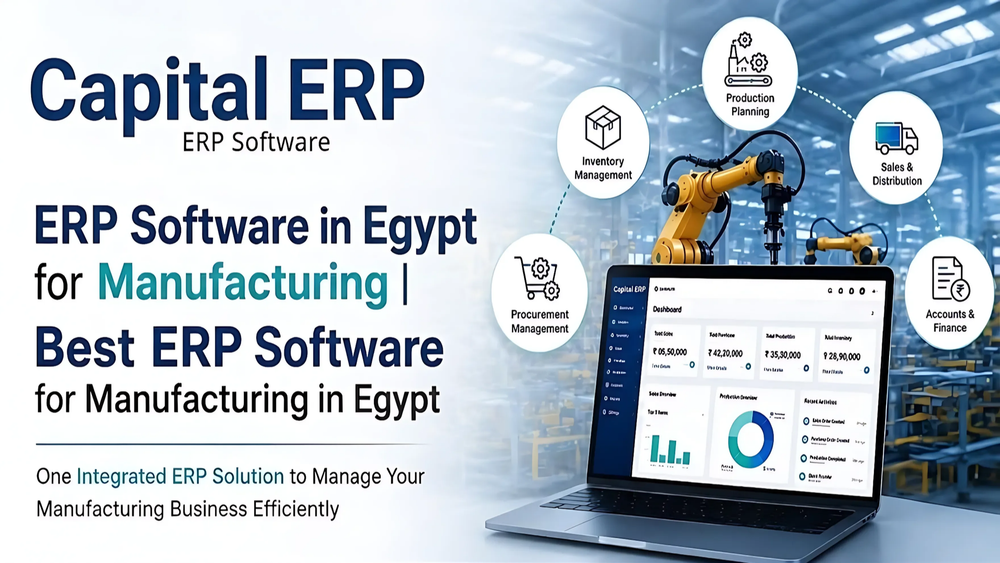
For this reason, ECPA (Egyptian Certified Public Accountants) developed a specialized Manufacturing Module within its Capital ERP system. This module acts as a unified digital brain that connects machine operations, raw material consumption, and labor costs directly to accounting entries and financial statements in real time and through automated processes.
What is a Manufacturing Management System?
A Manufacturing Management System is an integrated software solution specifically designed to control industrial and financial operations within manufacturing companies. Its primary function is to translate every physical event occurring on the factory floor into an organized financial and inventory transaction.
The system tracks raw materials from the moment they enter the warehouse, through cutting, forming, assembly, and work-in-progress stages, until they become finished goods stored in warehouses or delivered directly to customers. Throughout this process, all related accounting treatments are automatically executed in real time.
Importance of Manufacturing Management Systems in Improving Production Efficiency
Implementing a professional manufacturing management system significantly improves operational efficiency through:
Eliminating Time Waste: Advanced production planning and scheduling based on actual machine capacity help prevent production line downtime.
Real-Time Quality Control: The system detects operational errors immediately, preventing defective products from continuing through the production process.
Reducing Overall Costs: Automatic raw material allocation and accurate inventory costing prevent unnecessary purchases that tie up cash in excess inventory.
Data Security: Manufacturing formulas and technical product specifications are protected within encrypted databases with controlled access permissions.
How Does the System Organize Manufacturing Processes?
The ECPA Manufacturing Module divides production operations into separate, logically structured screens that follow the workflow inside the factory:
Work-in-Progress (WIP) Management
This screen enables monitoring of semi-finished products, calculating direct and indirect costs, and comparing standard production hours with actual labor hours.
Finished Goods Management
Used to record completed products and link sub-production stages to main production processes while tracking completion percentages for each stage.
Direct Selling Screen
Designed for factories producing custom orders that are delivered directly to customers upon completion without passing through finished goods inventory.
Benefits of Using a Factory Accounting System
Integrating a factory accounting system provides powerful control capabilities, including:
Automatic Scrap Processing: The system identifies damaged quantities during production and automatically generates the corresponding accounting entries.
Labor and Wage Calculation: Links machine operation hours, employee working time, and wage rates to accurately allocate direct labor costs.
Proactive Alerts: AI-powered notifications warn users before potential issues arise, such as raw materials nearing expiration.
Unified Coding System: A customized chart of accounts codes items, suppliers, customers, and cost centers to prevent account overlap.
Difference Between a Factory Accounting System and a Manufacturing Management System
Many people confuse these two concepts:
Factory Accounting System
Focuses primarily on financial transactions such as purchase and sales invoices, account statements, general ledger entries, treasury and banking activities, and profit and loss calculations.
Manufacturing Management System
A broader solution that includes accounting functions while also managing physical operations such as raw material consumption, machine maintenance scheduling, work order allocation, packaging quality control, and logistics tracking.
Role in Cost and Inventory Management
One of the most powerful features of a manufacturing management system is Cost Variance Analysis.
Before production begins, management enters the expected Standard Cost of a product based on market prices and standard performance rates. Once production is completed, the system calculates the Actual Cost.
If differences occur between the two, the system immediately analyzes the variance and identifies whether it resulted from increased raw material prices, excessive material waste, or operational inefficiencies.
How the System Calculates Product Costs Accurately
The ECPA Manufacturing Module applies scientific cost allocation methods:
Direct Costs
Includes the value of raw materials and direct labor involved in manufacturing the product.
Indirect Costs
Such as factory rent, electricity, machine depreciation, and administrative expenses. The system allows customized allocation bases for each cost element.
Cumulative Stage Costing
The cost of each production stage is carried forward and added to the next stage until the final product cost is calculated.
Managing Production Orders
The Production Order screen in Capital ERP ensures strict operational control.
The process starts by selecting the product, required quantity, and source warehouse. The system compares issued raw materials with actual production quantities, helping prevent inventory leakage and ensuring accountability for all consumed materials.
Raw Material and Inventory Control
Raw materials represent a factory’s true capital. ECPA provides complete inventory control through:
Auto-Reservation: Required materials are automatically reserved once a production order is approved.
Lot and Expiry Tracking: Supports FIFO (First In, First Out) inventory management.
Real-Time Inventory Valuation: Provides accurate reports on available materials, work-in-progress items, and finished goods.
Purchasing and Supplier Management
The system integrates purchasing with inventory management by linking reorder points directly to the purchasing department.
It records supplier information, tracks purchase orders, matches received goods with invoices, schedules payments, and monitors delivery dates.
Integration of Sales, Production, and Inventory
The true value of ERP lies in integrating all departments:
Sales
Receives customer orders and creates sales orders.
Production
Automatically reads sales orders, checks production capacity, and schedules manufacturing activities.
Inventory
Receives notifications to prepare raw materials and later receives finished goods ready for distribution.
Information flows instantly between departments without the need for manual communication.
Reporting and Decision Support
The Manufacturing Module provides executive dashboards and reports including:
Finished goods production reports.
Raw material consumption reports.
Material availability versus production reports.
Production order variance reports.
Overall manufacturing performance reports.
Reports on unfinished or delayed production orders.
Are Free Manufacturing Systems Suitable for Factories?
Many startup factories consider free manufacturing software. However, such systems often lack:
Advanced standard costing engines.
Strong database security.
Compliance with electronic invoicing and tax regulations.
Professional technical support.
Investing in a professional paid solution like Capital ERP helps protect the factory’s capital and operational continuity.
Criteria for Choosing the Best Manufacturing Management System
When selecting a manufacturing system, consider:
Accounting Expertise: Developed under the supervision of certified accountants familiar with taxation and industrial costing.
Scalability: Ability to grow with your business without losing historical data.
Integrated ERP Structure: Seamless connection with HR, Sales, Accounting, and Inventory modules.
Support and Responsiveness: Availability of a qualified support team and user training services.
How Manufacturing Systems Reduce Errors and Increase Profitability
Profitability is achieved not only through higher selling prices but also by reducing costs.
By preventing unnecessary purchases, identifying inefficient machines, monitoring energy consumption, and accurately allocating labor costs, the system reduces production costs and increases profit margins while enhancing market competitiveness.
Frequently Asked Questions
What is the Best Manufacturing Management System?
The Manufacturing Module within Capital ERP by ECPA is considered one of the best solutions because it combines strict accounting accuracy with real-time production and inventory control.
Can a Factory Accounting System Manage Production and Inventory?
Traditional accounting systems cannot. However, ERP-integrated industrial accounting systems such as Capital ERP are specifically designed to manage inventory, reserve raw materials, and track production orders alongside financial transactions.
Is There a Free Manufacturing Management System?
Some open-source or trial solutions exist, but they generally lack security, advanced cost analysis capabilities, and tax integration, making them unsuitable for managing a real manufacturing operation.
Does the ECPA Manufacturing Module Support E-Invoicing?
Yes. Capital ERP supports direct integration with approved electronic invoicing service providers and provides real-time invoice status updates.
Can the System Manage Assembly-Based Manufacturing?
Yes. The system includes a dedicated Assembly and Packaging Module designed for factories that assemble ready-made components into finished products in a simplified single-step process, while simultaneously handling raw material consumption, finished goods receipt, and expense allocation.