
Registration in the E-Invoicing System: A Practical Step-by-Step Guide
Registering in the Egyptian E-Invoicing System represents the first and most important step toward digital tax compliance for any company operating in Egypt. Although the process may appear straightforward on paper, many companies face practical difficulties due to incomplete documentation, outdated information, or an underestimation of the technical requirements.
 Tamer mohamednosair - • Tax services and everything related to taxes
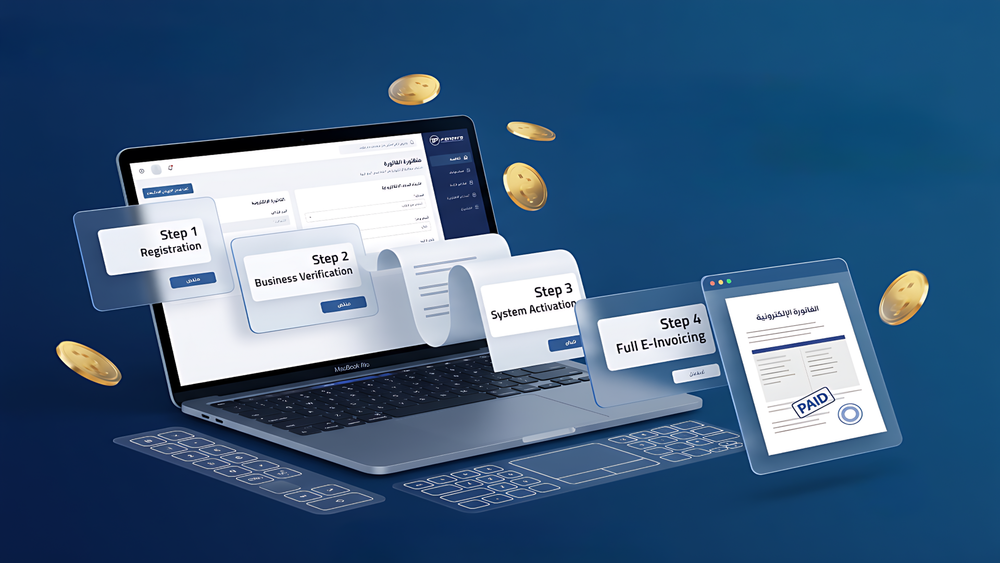
Registration in the E-Invoicing System: A Practical Step-by-Step Guide
Registering in the Egyptian E-Invoicing System represents the first and most important step toward digital tax compliance for any company operating in Egypt. Although the process may appear straightforward on paper, many companies face practical difficulties due to incomplete documentation, outdated information, or an underestimation of the technical requirements.
Based on ECPA’s 26 years of experience and our successful completion of registration and integration processes for clients across 14 sectors, this article provides you with a complete roadmap covering the prerequisites, electronic seal issuance, digital profile creation, system integration, testing, and go-live, along with the most common challenges and their practical solutions.
Prerequisites Before Starting the Registration Process
Before taking any technical steps, it is essential to ensure that the company’s tax and administrative records are in order, as most cases of rejection and delays are caused by issues at this stage.
Make sure the following are available:
A valid tax registration and an updated tax card containing the correct business activity and address.
VAT registration whenever the applicable conditions are met under Law No. 67 of 2016.
An active account on the Egyptian Tax Authority’s electronic portal and an accurate, unified tax file.
Identification of the company’s legal representative and the person authorized to deal with the E-Invoicing System.
An official email address and dedicated telephone number for tax correspondence.
We always recommend conducting a comprehensive review of the company’s tax status before starting the registration process. Discovering discrepancies in the data after the procedures have already begun may require the entire process to be restarted.
Step One: Obtaining the Electronic Seal Certificate
The electronic seal is a digital certification issued by licensed entities. It is used to electronically sign invoices, proving that they were issued by your company and protecting them against tampering.
Registration in the E-Invoicing System and the issuance of electronic invoices cannot be completed without this certificate.
Documents Required to Obtain the Electronic Seal
Legal entity documents, including the Commercial Register, Tax Card, and Articles of Incorporation, depending on the company’s legal form.
Identification documents of the legal representative, along with an official authorization if the applicant is not the legal representative.
Selection of the method for storing or using the certificate, such as a secure storage device (Token) or institutional digital-signature solutions, depending on the licensed provider.
Fees and issuance times vary from one provider to another. The process generally takes several business days when all required documents are complete.
For this reason, we recommend making this one of the first steps, as it is usually the most time-consuming part of the registration process.
Step Two: Creating the Digital Profile on the System
After obtaining the electronic seal, the next stage is to create the company’s digital profile within the E-Invoicing System. This is done through a registration invitation activated using the company’s information registered with the Egyptian Tax Authority.
This stage includes:
Activating the company’s account on the system and verifying the legal representative’s information.
Entering the company’s basic information, including branches, business activities, and official contact details.
Adding authorized users and assigning specific permissions to each user, such as issuing invoices, inquiries, or system administration.
Registering the ERP systems or Point-of-Sale (POS) systems that will be connected to the E-Invoicing System and obtaining the required integration credentials.
Starting the coding of goods and services according to the approved coding systems. This is fundamentally an accounting process that requires a proper understanding of the nature of the products and services rather than simply entering data.
Step Three: Choosing the Issuance Method — System Integration or Free Portal?
The E-Invoicing System provides more than one method for issuing invoices. The appropriate option depends on the volume of invoices and the company’s existing systems.
Comparison | ERP / Invoicing Software Integration | Free E-Invoicing Portal |
|---|---|---|
Best suited for | Companies issuing multiple invoices daily | Small businesses with limited invoices |
Data entry | Automated through the sales cycle | Manual, invoice by invoice |
Human errors | Limited when properly configured | More likely under pressure |
Cost | Initial integration and configuration cost | No software cost |
Reconciliation with accounting records | Direct and systematic | Requires additional effort |
At ECPA, we implement integrations with systems such as Odoo, Zoho, Capital, and others. We also help small businesses organize their invoicing processes through the free portal until their needs justify moving to a fully integrated system.
Step Four: Testing Environment and Go-Live
One of the most important steps in E-Invoicing System registration, and one that many companies underestimate, is testing before going live.
The system provides a testing environment that simulates actual operations. We recommend using it to verify:
Proper electronic signing of invoices using the electronic seal and successful acceptance by the system.
Correct product and service codes and applicable tax rates for each invoice line.
Return scenarios and electronic debit and credit notes.
The system’s handling of rejected invoices and error messages.
After successfully completing the tests, the company moves to the production environment.
From that point onward, every invoice issued through the system becomes an official document recognized by the Egyptian Tax Authority and carries a unique UUID.
Common Registration Problems and Practical Solutions
Documentation and Data Issues
Discrepancies between the Commercial Register and Tax Card, or having an outdated legal representative who has not been updated, are among the most common causes of delays.
Solution: Update the company’s information with the relevant tax office before starting the registration process. At ECPA, we handle this as part of a comprehensive review of the company’s tax position.
Electronic Seal Issues
Companies may encounter problems related to recognizing the signing device on their computers or may fail to notice that the certificate has expired.
Solution: Document the technical configuration and assign a specific person to monitor the certificate’s validity and renew it well before its expiration date.
Coding and Integration Issues
Invoice rejection due to incorrect product codes or incorrect tax settings in the accounting system is a common issue during the first weeks of operation.
Solution: Prepare an accounting-reviewed product and service master file from the beginning and test every product category in the testing environment before going live.
How Long Does Registration Take? Realistic Time Expectations
There is no single officially announced timeframe that applies to every case. However, based on our experience, a company with complete documentation and well-organized accounting records may complete the entire process — from obtaining the electronic seal to going live — within a few weeks.
The process may take longer if company information needs to be updated or if the accounting system requires configuration and integration.
The golden rule: Start early and do not wait until mandatory deadlines are approaching.
ECPA’s End-to-End E-Invoicing Registration Service
At ECPA, under the leadership of Mr. Ashraf Hager, who is registered as an Account Auditor with the Financial Regulatory Authority, we handle the entire E-Invoicing System registration process.
Our services include:
Reviewing the company’s tax position and updating its information.
Obtaining the electronic seal.
Creating the digital profile and managing user permissions.
Product and service coding.
Integrating the existing accounting system or implementing a new system.
Testing and go-live.
Training the company’s team.
With experience serving more than 1,270 clients, we understand where registration files typically encounter difficulties and how to avoid these problems from day one.
Frequently Asked Questions
Can I register in the E-Invoicing System myself without an accounting firm?
Yes, in theory. However, registration is closely connected to your tax file, product and service coding, and tax configuration within your accounting system.
Any errors in these areas may later result in rejected invoices or issues during tax inspections. Therefore, professional supervision should be viewed as an investment rather than a cost.
What is the first step in registering for the E-Invoicing System?
The first step is to verify that your tax registration is valid and that all company information is up to date. You should then immediately begin the process of obtaining the electronic seal certificate from a licensed provider, as this is usually one of the most time-consuming steps.
Is the electronic seal the same as a personal electronic signature?
No.
The electronic seal is a certificate issued in the name of the legal entity (the company) and is used to sign its invoices. A personal electronic signature, on the other hand, is associated with a specific individual.
For the E-Invoicing System, the required certificate is the company’s electronic seal.
Do I need an ERP system to complete registration?
No.
Businesses with a limited number of invoices can use the system’s free portal. However, as transaction volumes increase, automated integration through an accounting or ERP system becomes increasingly important for reducing errors and ensuring accurate reconciliation.
What happens after completing registration and going live?
The company becomes responsible for issuing all of its invoices through the E-Invoicing System, processing returns through electronic credit and debit notes, and regularly reconciling the system’s data with its accounting records and VAT returns in accordance with the latest instructions issued by the Egyptian Tax Authority.
Register Your Company in the E-Invoicing System with ECPA Experts
Save your team weeks of trial and error and let your registration file be handled by specialists who have successfully completed the process for companies across different industries.
Contact ECPA — Egyptian Certified Public Accountants — today and receive a clear registration plan with a defined timeline tailored to your company.